The Best iPad Accessories for Creative Professionals in 2026
IPad has been an attractive tool to do creative work. The difference in 2026 is that it is no longer an attractive alternative to a conventional setup – to a vast audience of illustrators, designers,…
IPad has been an attractive tool to do creative work. The difference in 2026 is that it is no longer an attractive alternative to a conventional setup – to a vast audience of illustrators, designers, photographers and video producers it is the setup. The iPad Pro has made it a truly professional creative tool with the combination of the M4 chip, a ProMotion OLED display and a fully developed accessory ecosystem.
However it is not just the hardware. The correct accessories make the iPad a legit creative work-minute or a costly machine that gets you frustrated the minute you get down to business. This guide includes the accessories that have the most significant impact, i.e. design, photography, video and all the above and below.
Apple Pencil Pro: Still the Best Stylus on Any Platform
The Apple Pencil Pro is the entry point, period to any creative professional who uses the iPad to do any drawing, lettering work, sketchwork, or detail work. Its stylus experience is the most natural on any tablet platform, with its pressure sensitivity, near-zero latency, and tilt recognition. The barrel roll support is included with the Pro model and is meant to detect rotation and translate it to brush orientation in apps such as Procreate and Adobe Fresco, which may not seem like a big deal, but which actually completely alters the experience of natural calligraphy and textured brushwork.
Magnetic charging and connecting to the side of the iPad ensures things are always tidy and the Pencil can be charged and ready whenever needed. To anyone who does client work, has to spend a long time illustrating or doing detailed retouching, the haptic feedback is a tactile responsiveness that makes long usage much less tiresome.
A practical remark: in case your case does not have a specific place to hold the Apple Pencil or a magnetic attaching point, you will eventually lose or break the Pencil. It is something that must have a safe place in your installation and not a pocket.
A Case That Works as Hard as You Do
The needs of a case can be quite different in creative professionals compared to the majority of iPad users. Not only do you need your device tilted at a low, shallow angle to draw, like your drafting table, but also not only upright to video call. That angle is necessary to support a rock-solid as you press with a stylus. And you should have sufficient security so that you do not handle your iPad like a delicate flower each time you put it in a bag.
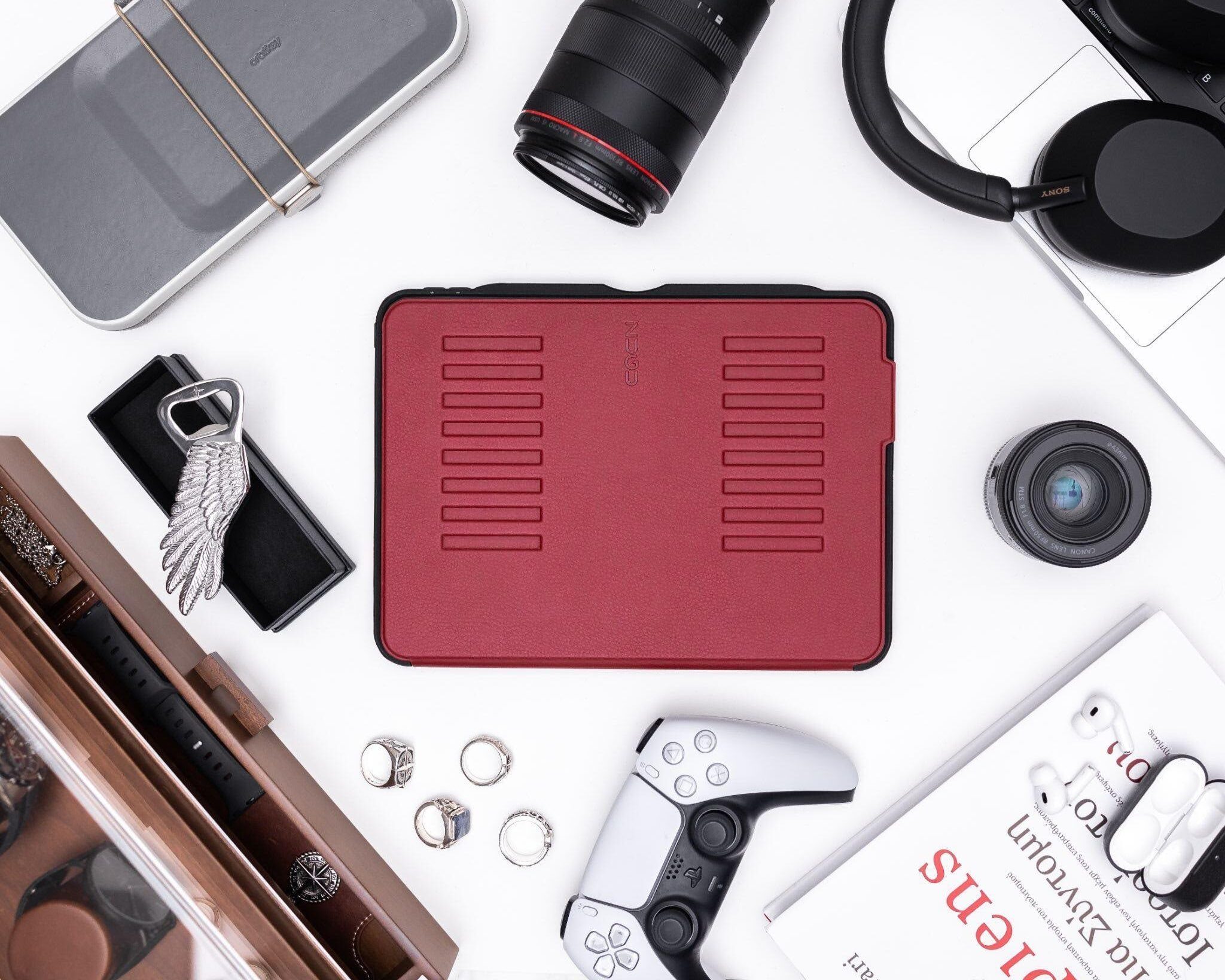
The ZUGU iPad case has become a go-to among professional illustrators and designers for exactly this reason. The magnetic stand system supports multiple precise viewing angles — including the low, drafting-table-style angles that drawing sessions demand — and holds them firmly under stylus pressure without wobbling or collapsing mid-stroke. That stability is not a minor detail. An unstable stand during a detailed illustration session is the kind of thing that makes you want to throw the whole setup out the window.
The fiberglass construction handles 5-foot drops, which matters when you’re moving between a studio desk, a café, and a client meeting on the same day. And the built-in Apple Pencil holder keeps the stylus secure and always accessible — no fumbling around in a bag when inspiration hits. For creatives who use their iPad as a primary tool rather than a secondary screen, the quality of the case is inseparable from the quality of the overall experience.
Procreate: The Creative App That Defined the Category
One could not discuss iPad accessories that are used by creative professionals without mentioning software that transformed the platform into what it is. Procreate is not really an accessory, but it has become so inseparable with professional illustration on iPad (that it makes sense to discuss honestly) that it should be included in any fair discussion of what makes the platform work.
The app supports thousands of layers, full canvasses of up to 16K and an enormous collection brushes and textures – all with the type of performance that would have once required a desktop. It has become the standard in the industry in digital illustration with Animation Assist, Reference layers, and an export to Photoshop or Illustrator, or directly to a client as a clean export. And if you do not know how to make use of it, you are over-working.
External Display: Expanding Your Canvas
More recent iPadOS updates have made the iPad Pro much more useful in its support of external displays and is opening a truly useful expanded workflow to creative professionals. Attaching the iPad to a bigger monitor via USB-C either an LG UltraFine or a quality 4k display allows you to use the iPad itself as a drawing tablet, with your reference, layers panel, or client presentation on the bigger screen.
It is an arrangement that resembles the way that many professionals work with a Wacom tablet and a desktop: draw something on one screen and see the result on another. The distinction lies in the fact that the iPad is a full-fledged computer by itself, and it thus does not involve a separate computer to maintain. Add a display output to a USB-C hub, two additional ports to add an SD card and other storage, and you’ve already put together a two-screen creative workstation out of a single gadget.
Screen Protector: Protecting the Surface You Draw On
A matte screen protector is a serious consideration to anyone who uses Apple Pencil on the iPad screen all day. The iPad has a beautiful glass surface that is beautiful to look but drawing on it is frictionless and slippery in a manner that does not mimic a paper or drawing tablet surface.
Matte screen protectors such as Paperlike or Bellemond do provide a slight texture that provides the Pencil with grip and resistance – and makes the strokes feel more intentional and controlled, especially when doing fine detail work. They also greatly minimize glare when using the studio lighting and even safeguard the screen surface against the cumulative wear of stylus use in time.
The trade off is a minimal decrease in display sharpness, which is important to photographers who require fine-tuning of their images. To the illustrators and designers though, the better feel of drawing usually supersedes with the visual compromise.
Audio: Focused Work Needs a Focused Environment
Prolonged creative work involves a long and demanding concentration, and a good pair of headphones is one of the most powerful tools of reaching concentration. Noise-cancelling over-ear headphones, like the Sony WH-1000XM5 or the Apple AirPods Max, can absorb the general sound of common studios, coffee shops, and open-desk offices in a manner that can bring deep work much closer.
To audio professionals and musicians in particular, an addition USB-C audio interface is worth considering. Such solutions as the Focusrite Scarlett Solo, or the IK Multimedia AXE I/O One, can be directly connected to the iPad through USB-C and turned into an effective recording and production studio. Both GarageBand and Logic Pro on iPad have now reached the level where they can easily be used to seriously produce music, without a desktop computer.
Read More: How Modern Technology Improves Sustainable Disposable Products
Storage and Backup: Don’t Learn This Lesson the Hard Way
Large creative files — high-resolution illustrations, RAW photo libraries, video footage — fill storage quickly and need to be backed up reliably. A USB-C SSD from Samsung or SanDisk connects directly to the iPad, offers fast transfer speeds, and gives you an immediate off-device backup that doesn’t rely on cloud connectivity.
For photographers in particular, a compact card reader that connects via USB-C lets you import directly from a camera card to the iPad and then to an external SSD in a single workflow — no computer required. It’s the kind of small addition that makes the iPad a complete field solution rather than a device that still depends on a laptop for the important stuff.
Building Around What You Actually Do
The best creative iPad setup is the one built around your specific discipline. An illustrator’s priorities — stand angle, Pencil feel, drawing stability — are different from a photographer’s, which are different again from a video editor’s or a musician’s. Start with the Apple Pencil if you draw. Start with external display support if you need screen real estate. Start with audio tools if you produce music.
What they all share is a need for a device that’s properly protected, stable in use, and set up to last a full working session without compromises. The accessories that support that — a serious case, a good stylus, the right peripherals for your workflow — aren’t optional extras. They’re what make professional iPad use actually work.