How AI Agents Are Redefining Customer Service Beyond Chatbots
A customer messages support about a damaged order. The bot asks for an order number, confirms the damage, and then says a representative will follow up within 24 hours. Nothing got resolved. The bot just…
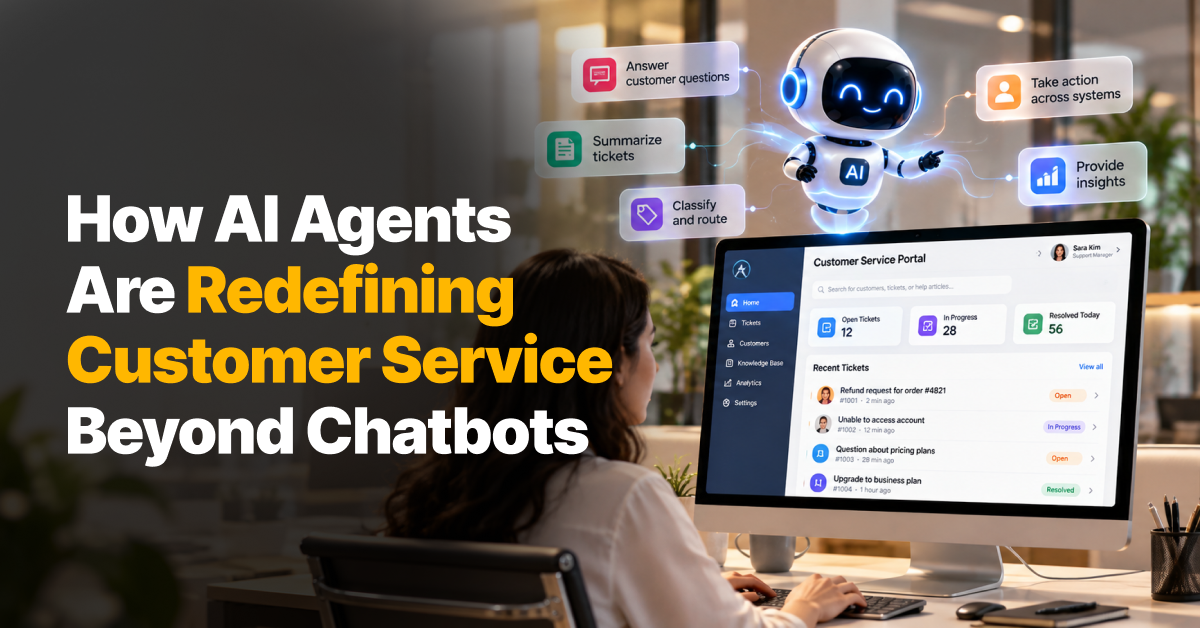
A customer messages support about a damaged order. The bot asks for an order number, confirms the damage, and then says a representative will follow up within 24 hours. Nothing got resolved. The bot just moved the problem to a queue.
This experience describes almost every chatbot interaction that goes beyond a simple question. Chatbots got good at answering things. They never got good at doing things, and customers noticed the difference immediately. Real agents built by a capable AI agent development company change that equation entirely, turning a conversation into an actual resolution.
An agent that can check order history, verify a return policy, and issue a refund resolves the same request inside the same conversation, without a human ever opening a ticket. That single capability separates a scripted bot from a system customers actually trust, and it changes what support teams can promise customers upfront.
This article looks at what changes when customer service moves past scripted flows into agents built to take real action. It covers where oversight still matters, and what a realistic rollout looks like for a team considering AI agent consulting for the first time.
Why Chatbots Plateaued as a Customer Service Solution
Chatbots solved a real problem for a while. They answered simple, repeated questions without tying up a human agent. That value stopped growing once customer requests got even slightly more complex, and businesses started looking at real AI agent solutions instead.
-
Scripted Flows and Unhandled Edge Cases
A chatbot follows a decision tree built in advance. Every branch someone anticipated works fine. Every branch nobody anticipated ends the same way, with a dead end or a generic apology. AI chatbot development services can still support structured customer interactions where FAQs, repetitive queries, and defined conversational flows are the primary requirement. Real customer requests don’t always stay inside the branches a designer imagined. A return involving a damaged item and a missing accessory needs two different flows at once, and most bots were never built to handle that overlap gracefully.
-
The Handoff Problem That Frustrates Customers
Once a chatbot hits its limit, it hands the conversation to a human. That handoff usually means the customer repeats information already typed into the bot minutes earlier. Context gets lost in the transfer almost every time.
This handoff is the single biggest source of frustration in scripted customer service. Customers do not mind talking to a bot first. They mind having to start over once a human finally joins the conversation. An AI agent development company studying this pattern usually finds the same root cause behind most complaints. The system never actually understood the case. It only collected words to pass along to someone else.
-
Customer Expectations Moved Faster Than the Tools
Customers now compare every support interaction against the fastest one they have ever had. A same-day resolution from one company resets the bar for every other company they deal with afterward. Chatbots built years ago were designed against a lower bar. Expectations moved. Most scripted tools never caught up, which is exactly why so many customers describe chatbots as an obstacle rather than a help.

What Changes When an Agent Can Take Action
The real difference is not a smarter chatbot. It is a system that can do something with the information it gathers, instead of just repeating it back to a human.
-
Resolving Issues Instead of Just Answering Questions
An agent connected to order systems, refund tools, and account records can complete a request directly. A damaged order gets a replacement scheduled in the same conversation, without a ticket sitting in a queue overnight. This change redefines what “resolved” actually means for a support team. A resolved case now means the customer’s problem is fixed, and not just that their message was acknowledged and filed somewhere for later.
-
Pulling Context From Order History and Account Data
A useful resolution depends on context a chatbot never had reliable access to. Order history, account tier, and prior support interactions all inform what the right resolution actually looks like for that specific customer. Agents built to actually resolve customer issues pull this context automatically, before a customer has to explain their situation from scratch. That single change removes most of the repetition customers complain about.
-
Handling Multi-Step Requests Without a Human Relay
Some requests genuinely need several steps completed in sequence. Verifying eligibility, checking inventory, and issuing a replacement might all need to happen before a case actually closes. An agent can complete each step in order, without relaying the case between departments. What once took two or three internal handoffs now happens inside one continuous interaction the customer never sees split apart. Building this kind of sequencing correctly takes real engineering discipline. An AI agent development company with genuine multi-step experience designs for the order these actions need to happen in, not just the individual actions on their own.
Where Human Oversight Still Belongs
Giving an agent the ability to act does not mean removing people from customer service. It means placing people where judgment genuinely matters most.
Escalation Triggers for Sensitive or High-Value Cases
A high-value refund, a legal complaint, or an angry customer threatening to leave deserves a person’s attention. Clear escalation triggers route these cases to a human automatically, based on defined criteria rather than guesswork. Building these triggers correctly takes real thought during design. A trigger set too low escalates far more than necessary. One set too high lets a sensitive case slip through without the review it deserved. Dollar thresholds, sentiment signals, and account tier all commonly feed into these triggers together. No single signal tells the whole story on its own, which is why strong designs combine several signals rather than relying on just one.
Keeping a Person in the Loop for Judgment Calls
Some situations do not fit a clean rule, even with good escalation design. A customer with an unusual, sympathetic circumstance might deserve an exception a rule was never written to allow. Agents built well recognize when a case falls outside their confidence range. They flag it for a person instead of forcing an answer, which keeps trust intact even in the cases a system cannot fully resolve alone.
This kind of self-awareness has to be designed deliberately. A system left to guess when it is uncertain will eventually guess wrong on a case that mattered, and that single wrong guess can undo months of built-up trust.
Reviewing Agent Decisions After the Fact
Oversight does not stop once a case closes. Reviewing a sample of resolved cases regularly catches patterns a single escalation trigger might miss entirely.
This review process also improves the system over time. Patterns found during review often turn into new rules or new triggers, refining what the agent handles well versus what still needs a person’s judgment.
Schedule these reviews on a fixed cadence rather than waiting for a complaint to trigger one. Monthly reviews catch drift early, long before a pattern turns into a real customer complaint worth escalating publicly.
Measuring Impact Beyond Response Time
Response time was always the easiest metric to track, and also the least meaningful one on its own. Real impact shows up in numbers response time never captures.
Resolution Rate and Repeat Contact Reduction
Resolution rate measures whether a case actually got fixed, not just acknowledged quickly. A fast response followed by three more contacts about the same issue was never a real win.
Track this number by issue type rather than as one blended average. A ninety percent resolution rate on account questions can hide a forty percent rate on billing disputes, and that gap deserves its own attention.
Repeat contact reduction tells a similar story from a different angle. Fewer customers reaching back out about the same problem is a far stronger signal than a fast first reply ever was.
Customer Effort as a Real Metric
Customer effort measures how much work a customer had to do to get their problem solved. Repeating information, waiting on hold, or contacting support twice all raise this number considerably.
An agent that resolves a case in one conversation, without repetition, lowers customer effort directly. This metric correlates closely with loyalty, often more closely than satisfaction scores collected right after a single interaction.
Ask customers directly how much effort a resolution took, through a short survey sent right after the case closes. This single question often predicts repeat business better than a five-star rating ever does.
Cost per Resolution Compared Across Channels
Cost per resolution ties the whole picture together financially. A chatbot might look cheap per interaction while producing a high volume of unresolved handoffs that cost more further downstream.
Comparing true cost per resolution usually reveals that a well-built agent costs less overall. The savings come from fewer repeat contacts and fewer cases needing a full human handling from scratch.
A transparent AI agent development company will help calculate this comparison honestly during scoping, using your own support data rather than generic industry averages that seldom reflect your actual case mix.
What a Realistic Rollout Looks Like
A realistic rollout starts with one workflow, not the entire support operation at once. Returns, order status changes, or account updates make reasonable starting points, since they combine clear rules with real customer value.
Pick a workflow with enough volume to produce meaningful results within a few weeks. A rare edge case, even a high-value one, will not generate enough data to prove the approach works reliably before wider rollout.
Run the agent alongside existing support channels before removing any human step. Compare its resolutions against what a human would have done for the same cases. This comparison builds internal confidence before any customer-facing change goes live.
Involve frontline support staff in this comparison directly, rather than leaving the review entirely to a project team. Staff handling these cases daily often spot subtle mismatches a metrics dashboard alone would miss completely.
Expand gradually once results hold up across a meaningful sample of cases. A capable AI agent development company will recommend this pace directly, rather than pushing for a faster rollout that looks impressive in a pitch but risks customer trust in practice.
What Customers Actually Notice
Customers don’t really think about whether they are talking to a bot or an agent. They notice whether their problem got solved, and how much effort it took them to get there. That is the real measure of progress behind this change.
The businesses seeing the strongest results treated resolution as the goal from the start. They built agents around actual customer requests, not around a simplified version of what support teams imagined those requests to be.
Every metric covered in this article points back to the same underlying question. Did the customer’s actual problem get solved, with as little friction as possible along the way. Response time never answered that question well, even though it was the easiest number to put in a dashboard.
Support leaders who internalize this distinction end up building very different systems than those still chasing faster replies. They design for outcomes a customer actually cares about, then let the operational metrics follow naturally from there.
An AI agent development company that understands this difference builds systems people actually want to interact with again. The chatbot era taught customers to expect a wait after every bot conversation. The agent era is teaching them something different, one resolved case at a time.