Jonathan Blow’s New Puzzle Game Launches With Over 1,000 Challenges and Overwhelmingly Positive Steam Reviews
Jonathan Blow's new puzzle game, Order of the Sinking Star, features over 1,000 handcrafted challenges and has received overwhelmingly positive reviews on…
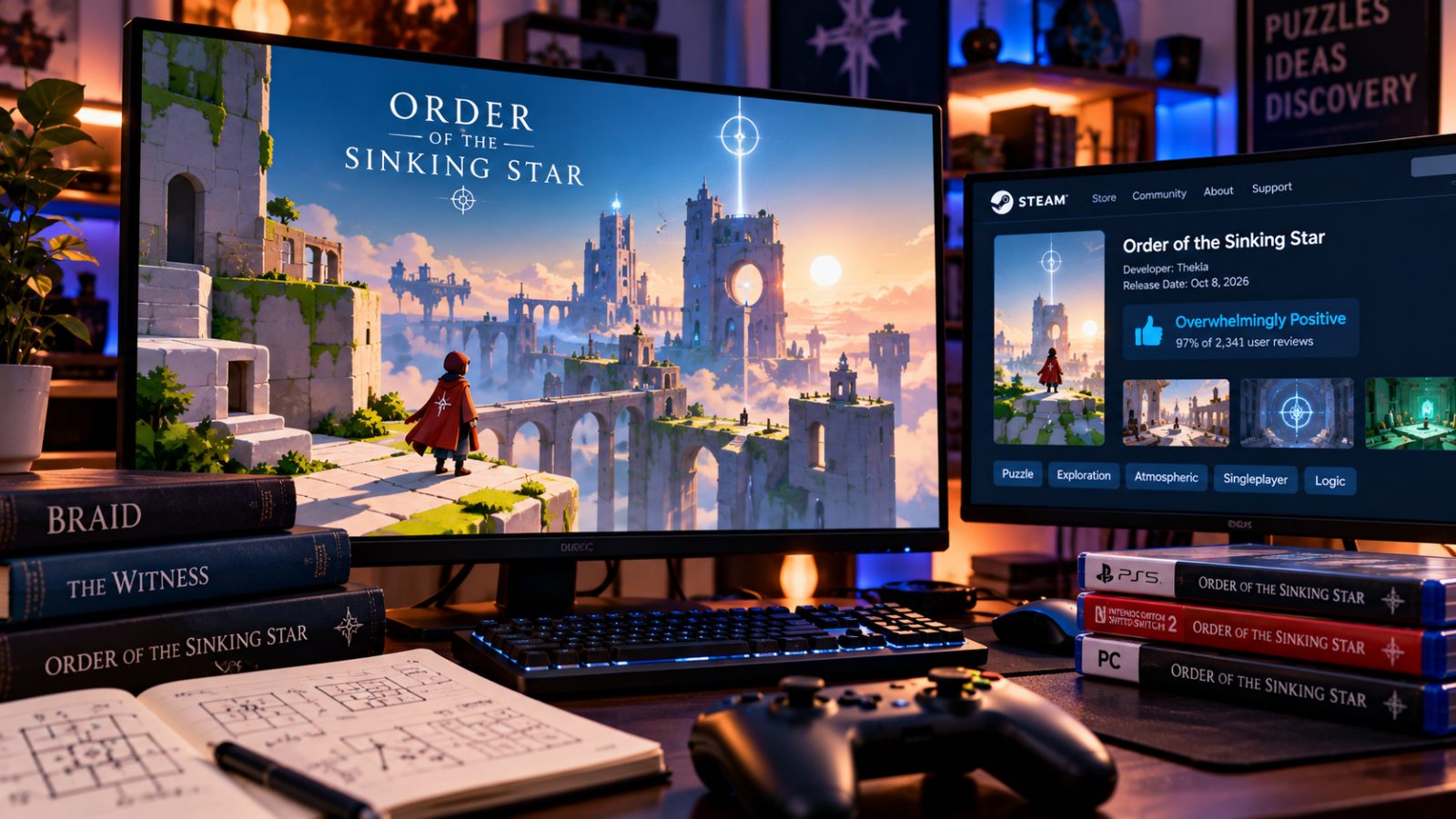
Order of the Sinking Star arrived on October 8, bringing an ambitious puzzle adventure from the creator of Braid and The Witness. Its early reception suggests that carefully designed logic games still have a strong audience in an increasingly crowded gaming market.
Puzzle games rarely need spectacular graphics or complicated combat systems to challenge players. Sometimes, a handful of rules and an unfamiliar environment are enough to produce hours of compelling gameplay.
That philosophy is at the heart of Order of the Sinking Star, the latest project from acclaimed game designer Jonathan Blow.
Released on October 8, 2026, the game features more than 1,000 handcrafted puzzles spread across an interconnected world. Players must explore different environments, understand unfamiliar mechanics and gradually discover how seemingly separate challenges fit together.
The title is already attracting considerable attention on Steam, where its English-language user reviews have reached an Overwhelmingly Positive rating.
Developed by Thekla, the studio behind The Witness, the new release represents another ambitious attempt to push puzzle design beyond familiar conventions.
More than 1,000 puzzles in one interconnected world
One of the most striking aspects of Order of the Sinking Star is its scale.
Rather than presenting a straightforward sequence of independent levels, the game introduces four distinct worlds, each featuring its own characters, environments and puzzle mechanics.
As players progress, these worlds begin to interact.
Mechanics introduced in one area can eventually influence challenges elsewhere, creating situations that require players to reconsider what they have previously learned.
According to the official game website, the adventure includes more than 1,000 handcrafted puzzles and potentially hundreds of hours of gameplay.
The developers estimate that particularly dedicated players could spend over 500 hours exploring everything the game has to offer.
However, the appeal is not simply the number of challenges.
The central idea is to encourage experimentation, allowing players to discover rules through interaction rather than relying on lengthy tutorials.
This approach rewards observation, patience and the ability to recognise patterns.
Jonathan Blow returns to ambitious puzzle design
Jonathan Blow has established a reputation for creating games that challenge conventional approaches to problem-solving.
His earlier releases, Braid and The Witness, became influential examples of how interactive entertainment can explore complex ideas through relatively simple mechanics.
Braid combined traditional platforming with time manipulation, forcing players to rethink how movement and consequences worked.
The Witness took a different approach, presenting an open environment filled with interconnected visual puzzles that gradually introduced increasingly sophisticated rules.
Order of the Sinking Star continues this interest in discovery but introduces a much larger collection of interacting systems.
The new game also draws inspiration from Sokoban-style puzzles, where players must move objects through constrained environments.
These mechanics create challenges in which individual decisions can affect the availability of future solutions.
A single movement may open a route, block access to an essential object or require an entirely different approach.
Steam players respond positively to the launch
The early reception provides another notable development.
The game's Steam store page currently reports an Overwhelmingly Positive rating among English-language user reviews, with approximately 97% of the reviewed experiences receiving a positive recommendation.
The figures are subject to change as additional players submit their opinions.
Nevertheless, the initial response suggests that there remains considerable enthusiasm for demanding puzzle experiences.
The game launched for PC through Steam, as well as PlayStation 5 and Nintendo Switch 2.
Its availability across multiple platforms should make it accessible to a broader audience than a PC-exclusive release.
For players who enjoy methodical exploration and difficult challenges, it offers an alternative to the faster-paced experiences commonly associated with major gaming releases.
Why hidden information remains such an effective game mechanic
One reason puzzle games remain popular is their ability to create tension through incomplete information.
Players often begin with a limited understanding of their surroundings.
Every action reveals something new, whether it is a hidden pathway, an unexpected rule or the consequences of an earlier decision.
Classic Minesweeper offers a familiar example of this principle.
The player must uncover a grid while using numerical clues to identify the location of concealed mines.
Success depends on interpreting available information and applying logical deduction, although some board configurations can also introduce unavoidable guesses.
The same visual concept of revealing concealed tiles has been adapted into other forms of digital entertainment.
For instance,Stake Mines uses a grid containing hidden hazards within a casino-style game involving real-money wagers.
There is an important distinction between the two formats. Traditional Minesweeper is primarily a logic puzzle, while casino Mines relies on chance and carries the risk of financial loss. The latter is intended for adults and is subject to applicable gambling laws.
Order of the Sinking Star is unrelated to these casino products, but the comparison illustrates how revealing hidden information can support very different gameplay experiences.
The challenge of making difficult puzzles feel rewarding
Designing a challenging puzzle game involves more than making solutions difficult to find.
Players need enough information to understand what they are trying to accomplish, even when the correct approach is not immediately apparent.
If a puzzle relies entirely on unexplained mechanics, frustration can quickly replace curiosity.
Conversely, a puzzle that reveals too much information may lose the satisfaction associated with discovering a solution independently.
Order of the Sinking Star attempts to balance these demands through gradual learning.
Its interconnected environments encourage players to apply knowledge gained from earlier challenges in new situations.
This can create moments when a previously confusing mechanic suddenly becomes understandable.
The result is a progression system based less on collecting rewards and more on expanding the player's understanding of the game.
Such an approach may be especially appealing to enthusiasts who prefer intellectual challenges over conventional progression systems.
A significant release for independent game development
The launch also demonstrates how independent studios can pursue distinctive projects without following the design conventions of major franchises.
Order of the Sinking Star has spent years in development, reflecting the considerable work involved in creating and testing an interconnected collection of puzzles.
Unlike games that rely heavily on recurring content updates or competitive multiplayer systems, its appeal centres on the quality of its challenges.
That approach gives the developers an opportunity to establish a strong identity in a crowded market.
However, it also introduces challenges.
Highly demanding puzzle games may struggle to attract players who prefer accessible experiences or immediate rewards.
The game's long-term reception will depend on whether its complexity remains satisfying throughout the adventure.
Puzzle games continue to find new audiences
Order of the Sinking Star arrives at a moment when independent developers are experimenting with increasingly varied approaches to puzzle design.
New releases continue to explore spatial reasoning, hidden information, unusual movement systems and unconventional narrative structures.
For players, this diversity means that puzzle games are no longer defined by a single format.
Some provide short challenges suited to casual sessions, while others offer expansive adventures requiring substantial commitment.
Jonathan Blow's latest release clearly belongs to the second category.
Its combination of more than 1,000 handcrafted puzzles, interconnected mechanics and an initially enthusiastic Steam reception makes it one of October's notable releases for fans of the genre.
The real test will be whether players remain engaged as the puzzles become more complex and the different worlds begin to overlap.
For now, Order of the Sinking Star demonstrates that even in an industry dominated by large-scale productions, a carefully constructed puzzle can still be enough to capture players' attention.