Advanced Hip and Knee Surgical Options: How to Know When You Need Joint Reconstruction
Joint reconstruction may be necessary when hip and knee pain persists despite conservative treatments. Early assessment can prevent further joint…
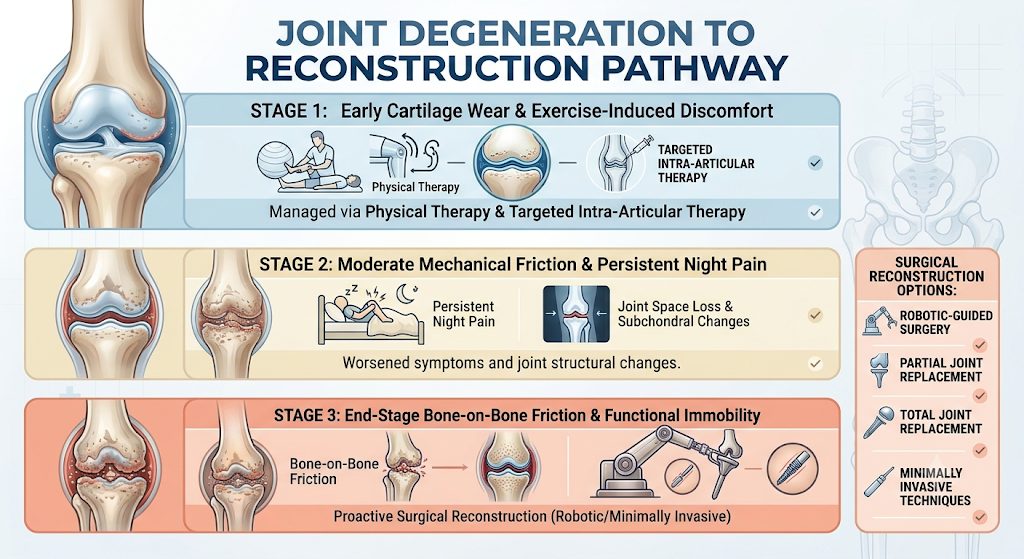
When minor movements are made challenging and painful due to constant pain in the hips and knees, despite the efforts of using conservative methods like injections and physiotherapy, surgery can be considered. Early assessment for the need for surgery will help prevent bone loss, muscle loss, and spinal shift because of changes in gait mechanics.
Accurate clinical delineation of conservatively treated patients vs. patients who are candidates for surgical reconstruction is largely dependent upon objective diagnostic imaging and scoring for functional disability. In the past, the focus for a joint replacement surgery was to be a last-ditch effort, when the joint was in end-stage destruction, but now surgical data indicates that waiting until this stage of destruction results in lower long-term mobility scores.
The patients seeking knee and hip replacement in Bangalore will get the advantage of utilising the latest robotic navigation technology and muscle-sparing techniques to preserve native tissue architecture. Proactive structural reconstruction of the hip has better implant longevity and quicker functional recovery than does reactive end-stage salvage.
Recognizing Clinical Indicators for Joint Reconstruction
The possibility of joint reconstruction can be considered in patients with nocturnal pain, rest pain, and/or functional immobility as a result of deterioration of joint structures even after specific conservative treatment. Joint space obliteration, as well as subchondral sclerosis and osteophytosis in radiographic images, is evidence of clinical symptoms.
Studies conducted and published in the Journal of Bone and Joint Surgery in 2025 demonstrated that the mobility score post-operation was 34% higher in patients who underwent total joint arthroplasty before developing functional weakness compared to those patients who had to wait for the muscles to deteriorate before they could undergo surgery. Relying only on pain for the treatment might overlook the fact that bone deterioration is still progressing. Early detection of structural joint failure results in the best bone quality for implant anchorage.
Comparing Modern Reconstruction Surgical Modalities
There are a number of surgical techniques available for advanced joint reconstruction that are custom tailored to the pattern of damage, age of the patient, and expectations of activity. The selection of the modality involves making sure the anatomical wear patterns match the right implant design.
|
Surgical Option |
Target Pathology |
Tissue Impact |
Typical Recovery Window |
|
TKA using robotics. |
Tricompartmental Osteoarthritis |
Bone Preserving, Sub-micron Technology |
2–4 Weeks |
|
Unicompartmental (Partial) Knee Repair |
Isolated Compartment Wear |
Cruciate Ligament Sparing |
1–2 Weeks |
|
Anterior Approach Hip Reconstruction |
Femoral Head Necrosis / Advanced Hip OA |
Muscle-Sparing (No Tendon Cut) |
1–3 Weeks |
|
Custom Revision Joint Reconstruction |
Failure of implants, or severe bone loss. |
Complex Structural Augmentation |
6–12 Weeks |
In 2024, the study published in the National Joint Registry stated lower 90-day complication rates and higher implant accuracy of alignment through the use of robotic assistance in joint surgery compared to manual instrumentation. It is necessary for the patients to address orthopedic specialists to comprehend their anatomical alignment and the right type of reconstructive surgery to choose: partial, total or robot-assisted.
The Joint Reconstruction Workflow
Joint reconstruction has a well-designed workflow that aims to reduce tissue damage, control systemic inflammation, and support fast recovery after surgery.
- Pre-operative digital mapping: High-resolution CT and MRI scans will be performed to develop an individual plan for the surgery and the virtual model of the implantation.
- Implantation with Minimally Invasive Techniques: Perform bone resections and implant placement with the help of computer-assisted or robotic navigation techniques.
- Post-operative Early Mobilization: Physical therapy to reduce the thromboembolism risk should be started 6–12 hours after the operation.
- Functional Rehabilitation Program: Perform an individual program of physical therapy in order to strengthen the quadriceps muscle, correct walking technique, and increase joint mobility.
Long-term Results Analysis and Implant Lifespan
Currently, highly cross-linked polyethylene, porous titanium, and ceramic surfaces have contributed to extending the lifespan of joint replacement.
- Bearing Surface Integrity: Materials such as advanced ceramics and oxinium will be helpful in reducing the volumetric wear rate and also minimizing the chances of periprosthetic osteolysis.
- Biologic Fixation: The porous coating of the implant will result in osseointegration, which provides mechanical stability that does not require bone cement.
- Kinematic Alignment: The concept of patient-specific alignment that aims to restore the natural joint line, which helps improve range of motion after rehabilitation, is known as Kinematic Alignment.
It is essential for patients who are planning for knee and hip replacement in Bangalore to verify the surgeon's experience and facility's infrastructure before proceeding with surgery.
Questions You May Ask
What determines whether I need a total or partial joint replacement surgery?
Partial replacement is indicated if damage is within a single compartment, while total reconstruction is necessary if multiple arthritic compartments exist or if there is a widespread structural deformity.
How long do hip and knee implants last?
Studies from the clinical registry data indicate that more than 90% of modern hip and knee implants are still working at 20-25 years.
What is the average walking time after joint reconstruction when patients are able to walk on their own?
Assisted walking is started on the day of surgery and is made easier to accomplish in 2-4 weeks so that the patient can walk freely without assistance.
Are robotic-assisted joint replacements better than standard surgery?
Robotic systems provide increased component positioning accuracy, sub-millimeter tolerances, decreased soft tissue trauma, and lower early revision rates.
Ways of Restoring Joint Function
Understanding some of the signs and symptoms of joint reconstruction can help turn physical limitations into full functional recovery. Early diagnosis, sophisticated surgical procedures and a carefully planned rehabilitation can help the patient to avoid joint pain, regain normal function and live an active life for many years.