Why Your AI Business Solution Needs Good Plumbing
An effective AI business solution relies on robust infrastructure to ensure reliability and performance. Without proper plumbing, even the best models can…
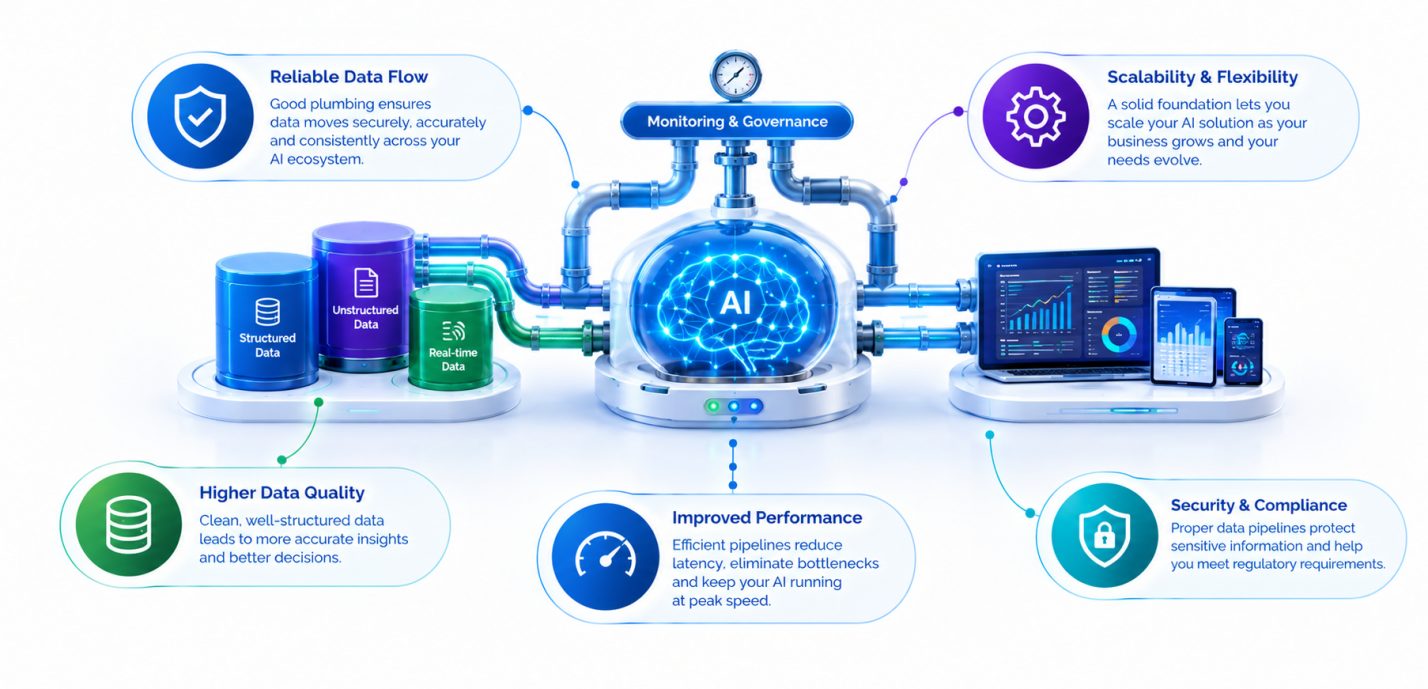
The demo always works. That is the trap. A clever model answers every question on stage, the room nods, and everyone assumes the hard part is done. Then it hits production, and the cracks show. Slow responses. Random failures. A model that worked on Tuesday and breaks on Friday. This is where most companies learn that an AI business solution is only as good as the machinery running it.
And that machinery is invisible until it fails. Nobody claps for a pipeline that ships a model safely. They just notice when it does not. The gap between a great demo and a tool people trust every day is almost never the model. It is everything around it.
What an AI business solution really needs to work
A model is one piece. A working product is the whole system. The data feeding it, the servers running it, the checks that catch it when it drifts.
A real AI business solution has to do more than answer well. It has to answer fast, stay up, and keep answering well next month. That takes plumbing. The unglamorous pipes that move data in, push updates out, and sound the alarm when something goes wrong.
The parts nobody puts in the demo
- Pipelines that retrain and redeploy the model without a fire drill.
- Servers that scale up under load and back down when it drops.
- Monitoring that spots a model drifting before users do.
- Rollback, so a bad update undoes itself in seconds.
Why a good model quietly goes bad
A model is not a finished building. It is more like a garden. Left alone, it gets worse. The world shifts, the data shifts, and the model keeps answering as if nothing changed.
This is called drift, and it is slow and quiet. The model does not crash. It just gets a little more wrong each week, until someone notices the numbers stopped making sense. Catching that early takes monitoring and a retraining pipeline. Without them, nobody sees the rot until it is a real problem.
Where a devops services company comes in
All this plumbing needs someone to build and run it. That is the job most teams underestimate. Data scientists build great models. They are rarely the people who should be running production servers at 2 a.m.
This is where a devops services company earns its keep. They build the pipelines that ship models safely, the monitoring that watches them, and the scaling that keeps costs sane. They treat the AI like a living product, not a one-time project.
The split is simple. The data team makes the model smart. A good ops partner makes it reliable. You need both, and the second one is the piece companies forget until something breaks.
How the two sides fit together
Picture a team shipping an AI feature the right way. The data scientists tune the model. The ops team wraps it in a pipeline that tests, ships, and watches it. When the model drifts, monitoring catches it, and a retrain goes out before customers feel a thing.
Now picture the common version. A brilliant model, handed to a team with no pipeline. It goes live, works for a while, then slowly degrades with nobody watching. Same model, opposite result. The difference is the plumbing, not the intelligence.
Where AI projects fall apart
Most AI failures are not about the model being dumb. They are about the system around it being thin.
- No retraining plan, so the model slowly drifts out of date.
- Manual deploys, so updates are rare and scary.
- No monitoring, so trouble shows up as angry users.
- Costs that balloon, because nobody right-sizes the compute.
Each one is a plumbing problem, not a brains problem. The right partner builds for these from day one, because they have watched all four sink projects before.
How to choose the right partner
The partner you pick shapes whether your AI holds up in the real world. A few signals tell you who is serious.
- They ask about production and upkeep, not just the model.
- They build monitoring and rollback from the start, not later.
- They plan for retraining, because every model drifts.
- They can show AI systems they keep running, not just demos.
A partner who talks as much about the day after launch as the launch itself is the one worth hiring. The rest are selling you a demo.
Frequently asked questions
What is an AI business solution?
It is AI built to solve a real business problem and run in daily use. A working one does more than answer well in a demo. It stays fast, reliable, and accurate in production.
Why do AI projects fail after a good demo?
Because a demo tests the model, not the system around it. In production the model needs pipelines, monitoring, and retraining. Skip those, and even a great model degrades.
What does a devops services company do for AI?
It builds and runs the machinery behind the model. That covers deploy pipelines, scaling, monitoring, and rollback, so the AI stays reliable over time.
What is model drift?
It is the slow decay of a model as the world changes around it. The model keeps answering the old way, getting a little more wrong each week until someone catches it.
How do we start without a huge project?
Put monitoring on one model first, so you can see drift. Add an automated deploy pipeline. Prove the setup holds, then extend it to the rest.
The bottom line
A clever model makes a great demo. A working AI business solution makes a great product, and the difference is everything you do not see on stage. The pipelines, the monitoring, the steady upkeep that keeps a model honest. A strong ops partner builds that quiet machinery, so your AI keeps working long after the applause fades. Get the plumbing right, and the intelligence finally has somewhere solid to stand.